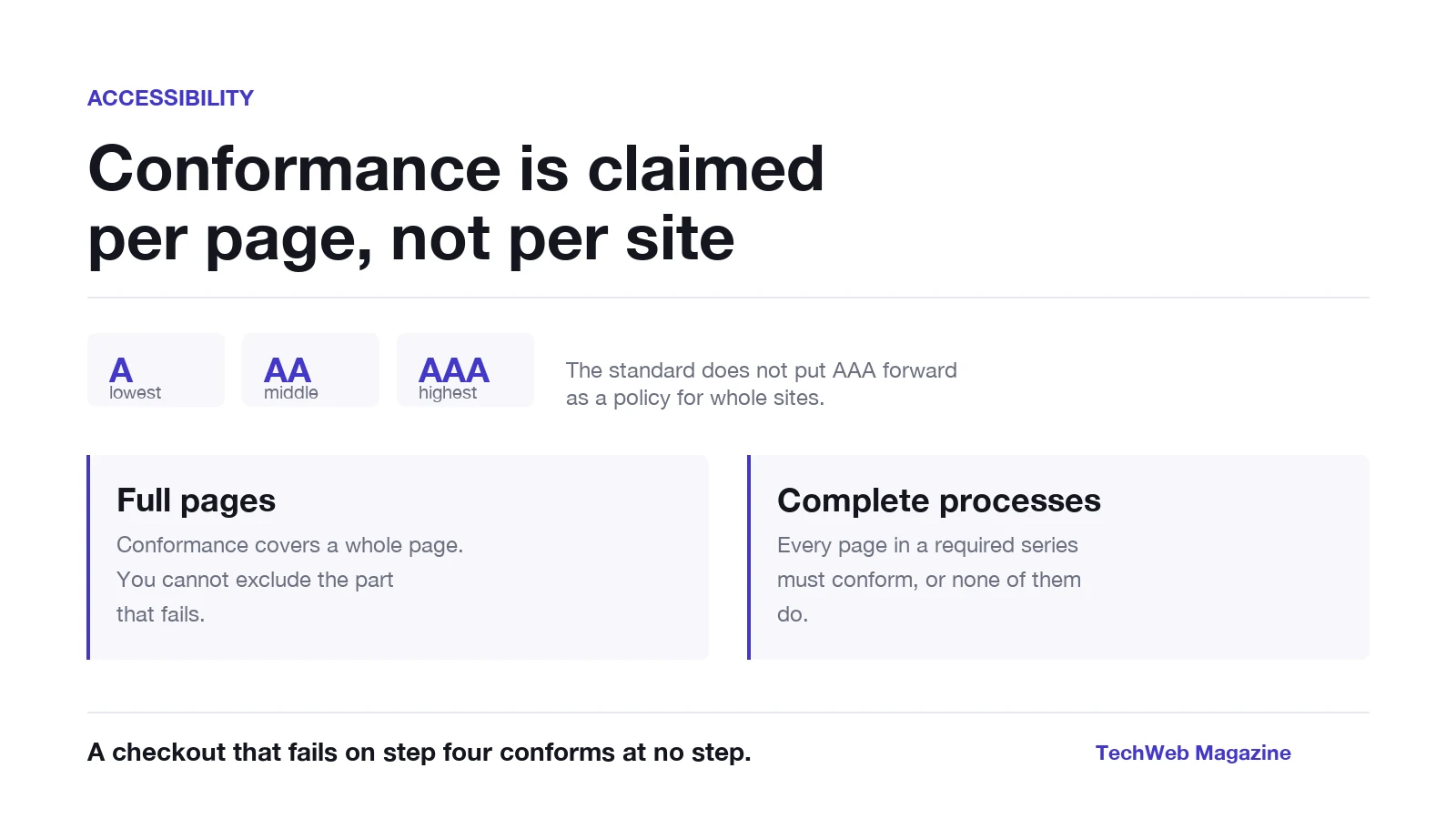
- WCAG has three levels: A is the lowest, AA the middle, AAA the highest. The standard does not put AAA forward as a policy for whole sites.
- Conformance is claimed for a full page, and for every page in a process that has to be completed in order, so a checkout that fails on step four conforms at no step.
- WCAG 2.2 content also conforms to 2.1 and 2.0, which decides who has met a contract that names an older version.
Accessibility gets quoted as a single number. A vendor says "we are AA compliant" and everyone nods. The number is the easy part. What it commits you to is narrower and stricter than most buyers assume, and two of the rules catch people out.
What the levels are
WCAG is published by the W3C through its Web Accessibility Initiative. It sets out three conformance levels: A is the lowest, AA sits in the middle, AAA is the highest. Each level adds criteria to the one below it.
The specification does not tell you to aim for AAA across a whole site. It sets the levels out as testable benchmarks and leaves the choice to you. Which level any law or contract requires is a separate question, and W3C keeps that on its own laws and policies page rather than in the standard.
The four principles behind the criteria
Every criterion sits under one of four principles. They are worth knowing because they explain why a rule exists, which makes the rule easier to apply.
| Principle | What it asks |
|---|---|
| Perceivable | "Information and user interface components must be presentable to users in ways they can perceive." |
| Operable | "User interface components and navigation must be operable." |
| Understandable | Text readability, stating the language, defining unusual terms, predictable behaviour, and helping people recover from errors |
| Robust | "Robust content is compatible with different browsers, assistive technologies, and other user agents." |
Robust is the one people skip. W3C's own framing is that meeting it "helps maximize compatibility with current and future user agents, including assistive technologies". It is not about today's screen reader. It is about the one your customer upgrades to next year.
Two conformance rules that catch buyers out
The standard sets five conformance requirements. Two of them decide whether a claim means anything.
Full pages. Conformance is claimed for a whole page, not for part of one. You cannot exclude the bit that fails. A page with an accessible article and an inaccessible booking widget is not a conforming page.
Complete processes. If a page is part of a series that has to be completed in order, every page in that series must conform. A checkout that is accessible for three steps and fails on the fourth does not conform at any step.
That second rule is the one to put in a contract. Most sites fail it in the same place: a payment step, a booking calendar, or a third-party form that nobody audited because nobody built it.
The other three, briefly
The remaining requirements cover how normative wording is read, using only accessibility-supported ways of relying on a technology, and non-interference: content that does not conform must still not block someone from using the rest of the page.
Which version applies
WCAG 2.2 is the current version. It was published in October 2023 and updated in December 2024. Versions build on each other rather than replacing each other.
W3C states that "content that conforms to WCAG 2.2 also conforms to WCAG 2.1 and WCAG 2.0", and it encourages using the latest version. That matters commercially. If a contract names 2.1 and your supplier delivers 2.2, they have met it. If the contract names 2.2 and they deliver 2.1, they have not.
What to ask a supplier
A conformance claim on its own tells you very little. These five questions turn it into something checkable.
| Ask | Why it matters |
|---|---|
| Which WCAG version and level? | 2.2 AA and 2.0 A are very different commitments |
| Which pages does the claim cover? | Conformance is per page, so "the site" is not an answer |
| Does it cover complete processes end to end? | Checkout and booking flows are where claims break |
| Who tested it, and when? | A claim ages every time the site changes |
| What is excluded, and why? | Third-party embeds are the usual gap |
Ask the last one first. The answer is usually short, and it tells you more than the other four together.
Where to start if you have nothing
Pick your highest-traffic complete process. For most businesses that is enquiry or checkout. Test that one flow end to end, not the home page.
The home page is the page everybody audits and the page nobody transacts on. A flow that works is worth more than a landing page that scores well.
Frequently asked questions
Is AA the legal requirement?
That depends on where you operate and what you do, and the standard itself does not say.
W3C keeps jurisdiction detail on a separate laws and policies page. Treat the level as a
contractual choice and take advice on the legal question.
Should we just aim for AAA?
The specification does not put AAA forward as a general policy for whole sites. Some AAA
criteria are not achievable for all content, which is why it is not the default target.
We conform on most pages. Can we say we are compliant?
No. Conformance is claimed per page, and a page that is part of a required series only
conforms if every page in that series does.
Does an accessibility overlay make us conform?
Conformance is a property of the content against the success criteria. Any tool has to be
assessed the same way, on the actual pages, after it is installed.
Sources
W3C, Web Content Accessibility Guidelines 2.2 · W3C WAI, WCAG overview · W3C WAI, Accessibility principles. Quoted wording is W3C's own. Legal requirements by jurisdiction are out of scope here and are covered on W3C's separate laws and policies page.
More in this section Business →