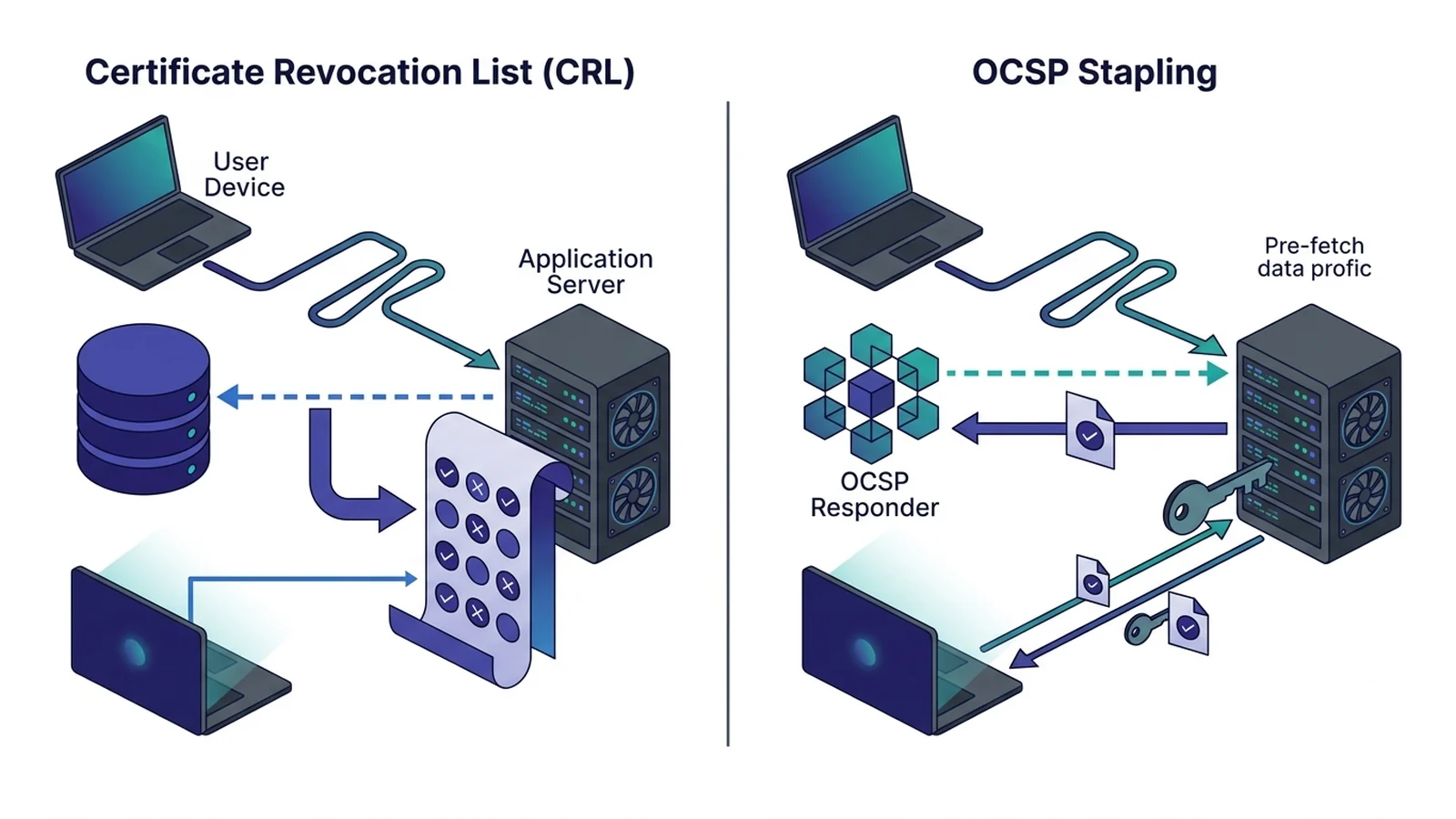
- Certificate Revocation Lists require clients to fetch large signed files.
- Direct OCSP queries leak user IP addresses and browsing habits.
- OCSP stapling binds signed proofs into the TLS handshake for speed.
CRL vs OCSP stapling protocol mechanics and trade-offs
When comparing crl vs ocsp stapling, systems engineers must balance network latency, client privacy, bandwidth costs, and server resilience. Traditional Certificate Revocation Lists force clients to download bulky files. In contrast, OCSP stapling embeds a fresh proof directly into the TLS handshake. This engineering guide evaluates protocol differences, analyzes soft-fail failure modes, and outlines production proxy configurations.
Every secure web visit relies on trust. When a private key leaks, the authority revokes it. Clients must check that status before sharing secrets. Bad keys risk data theft. Without fast checks, bad actors can impersonate real servers.
Two main tools handle key checks across public infrastructure. The first tool is the Certificate Revocation List from RFC 5280. The second tool is the Online Certificate Status Protocol from RFC 6960. Both tools guard users. Understanding how each tool runs helps teams build fast web stacks.
How Certificate Revocation Lists distribute revoked serials
A Certificate Revocation List acts like a public ledger. The issuing authority lists all revoked serial numbers in a signed file. It posts this file at a public web link. Clients call this link a distribution point.
When a browser opens a site, it reads the certificate details. It finds the distribution link and pulls the file over HTTP. Then it validates the digital signature. It scans the serial list to confirm that the server key is clean.
This design creates serious operational friction. As web traffic grew, these files swelled to many megabytes. Pulling big files over mobile links stalls connection setup. Clients also store these files for days, leaving caches stale until local records expire.
Direct OCSP queries and the visitor privacy dilemma
The Online Certificate Status Protocol solved bandwidth bloat. Instead of sending a giant database, it answers one query at a time. The browser asks if a single serial number is valid. The authority returns a short signed answer.
This payload is small. It takes less than one kilobyte of data. But direct queries bring a major privacy flaw.
Every time a user visits a site, their browser contacts the authority. The request shares the visitor IP address. It also exposes the specific domain name requested by the visitor. Authorities can track visitor browsing habits while slow responder servers delay page loading.
How OCSP stapling binds verification into the TLS handshake
RFC 6066 introduced a smarter workflow called OCSP stapling. This standard moves the checking task to the origin web server. The origin server queries the authority on a steady timer.
The server keeps this signed proof in memory. When a visitor starts a TLS handshake, the server attaches the cached proof to the certificate. The browser reads the proof right away. It makes no extra network calls across public internet routes.
Stapling solves both speed and privacy issues. Handshakes finish without extra delays. Browsers stay fast. The issuing authority never sees the visitor IP address. Only the origin server talks to the authority.
Architectural comparison of revocation mechanisms
| Evaluation factor | Certificate Revocation List (RFC 5280) | Direct OCSP (RFC 6960) | OCSP Stapling (RFC 6066) |
|---|---|---|---|
| Handshake latency | High (waits for full file download) | Medium (requires separate DNS and HTTP round trip) | Zero added round trips (included in TLS handshake) |
| Client privacy | High (authority cannot track individual site visits) | Low (authority sees client IP address and requested domain) | |
| Bandwidth consumption | Heavy (megabytes per certificate authority) | Low (under 1 KB per validation request) | Minimal (under 1 KB transmitted in server handshake) |
| Failure resilience | Vulnerable to download timeouts on mobile links | Single point of failure during responder outages | Resilient (server serves cached proof during short outages) |
| Revocation freshness | Delayed by list generation and client cache intervals | Real-time status generated by responder | Bounded by server cache refresh lifetime (typically hours) |
| Production adoption | Primary fallback and browser update lists | Deprecated by major public CAs | Standard requirement for high-performance edge proxies |
Soft-fail vulnerabilities and why CAs are retiring direct OCSP
Most web browsers use soft-fail checks for revoked keys. If an authority server stalls or drops packets, the browser opens the page anyway. Teams picked soft-fail rules to keep the internet working during minor network errors.
Soft-fail weakens real transport security. An attacker on the local network can drop all outbound verification packets. The client assumes the network is busy. It accepts the bad certificate without warning.
Because direct checks leak user data and fail open, major authorities have shifted their tools. Let's Encrypt shut down its public OCSP servers in August 2025. Modern setups now rely on server stapling and compact lists.
Production web server configuration for Nginx and Apache
Turning on stapling on edge proxies speeds up site handshakes while guarding visitor privacy. The web proxy needs a complete certificate bundle. It also needs a working DNS resolver to query authority servers in the background.
The snippet below enables stapling in Nginx. It defines an upstream resolver. It also verifies signatures against system roots.
# Enable OCSP stapling in Nginx
ssl_stapling on;
ssl_stapling_verify on;

# Trusted certificate chain
ssl_trusted_certificate /etc/ssl/certs/ca-certificates.crt;

# Upstream resolver for status queries
resolver 1.1.1.1 8.8.8.8 valid=300s;
resolver_timeout 5s;

# Preserve session cache
ssl_session_cache shared:SSL:10m;
ssl_session_timeout 1d;
Apache HTTP Server uses similar rules. Add these lines to your host file:
# Global Apache SSL Stapling Cache
SSLStaplingCache "shmcb:/var/run/apache2/stapling_cache(128000)"

# VirtualHost Configuration
<VirtualHost *:443>
    ServerName example.com
    SSLEngine on
    SSLCertificateFile /etc/ssl/certs/example.crt
    SSLCertificateKeyFile /etc/ssl/private/example.key
    SSLCACertificateFile /etc/ssl/certs/ca-bundle.crt
    SSLUseStapling on
    SSLStaplingResponseMaxAge 900
</VirtualHost>
Fast stapling complements modern ciphers. Small keys help servers. As shown in our review of RSA vs ECC certificate performance, elliptic curves reduce cryptographic packet sizes across busy networks. Read our breakdown on TLS 1.3 vs TLS 1.2 handshake speed to cut latency. Follow our checklist to confirm TLS certificate renewals.
Frequently asked questions about CRL and OCSP stapling
What is the core difference between a CRL and OCSP stapling?
A CRL downloads a full signed list of revoked keys. In contrast, OCSP stapling delivers a cached status token inside the TLS handshake.
Why did major Certificate Authorities end standalone OCSP responders?
Direct queries leak user IP addresses to third parties. They also cause handshake delays and fail open under network interference.
Does OCSP stapling work if the CA responder goes offline?
Yes. Edge servers cache signed responses for hours, serving valid tokens to visitors during temporary responder outages.
Why do browsers default to soft-fail revocation checking?
Browsers use soft-fail rules to prevent broken links when responders stall. Yet this choice lets attackers bypass revocation.
Sources and technical documentation
- IETF RFC 5280: Internet X.509 Public Key Infrastructure Certificate and CRL Profile.
- IETF RFC 6960: X.509 Internet Public Key Infrastructure Online Certificate Status Protocol.
- IETF RFC 6066: Transport Layer Security Extensions Certificate Status Request.
- Let's Encrypt: Ending End-Entity OCSP Service Announcement and Architecture.