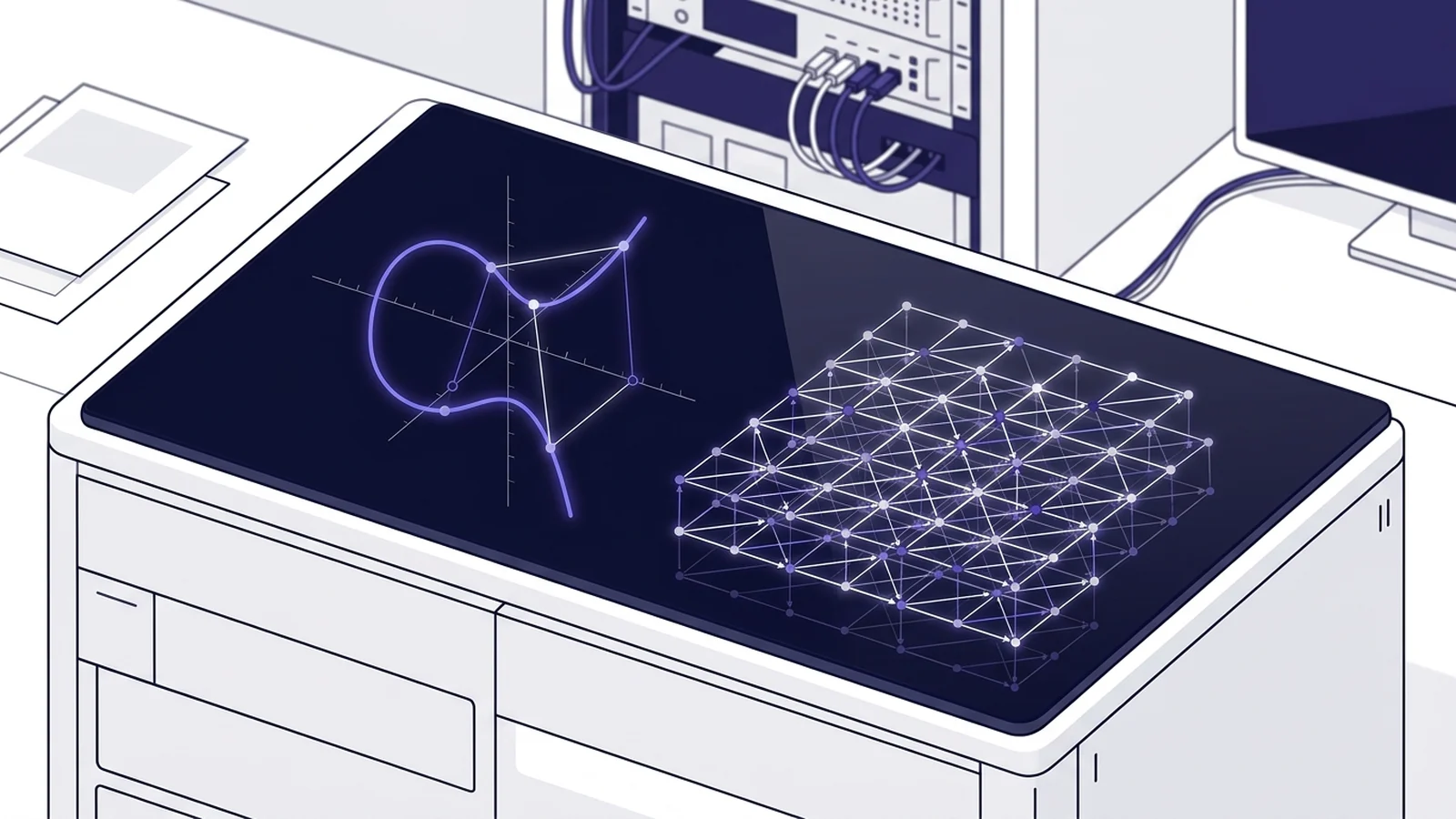
- ECC P-256 matches RSA 3072 strength with a key twelve times smaller.
- Smaller ECC certificates cut packet fragmentation across mobile cell connections.
- RSA still offers universal fallback for legacy enterprise devices.
- Dual certificate configuration delivers high speed without dropping old clients.
Core mathematical differences between RSA and ECC certificates
An RSA vs ECC certificate choice comes down to speed and client hardware: use ECC for fast handshakes and lower CPU use, and keep RSA when supporting older devices. Both tools give public-key math for server proof. But their math scales in different ways.
RSA depends on factoring large prime numbers. As chips get faster, RSA keys must grow huge to stay safe. A 2048-bit key is the bare floor today. Better security forces a jump to 3072-bit or 4096-bit sizes.
In contrast, ECC relies on elliptic curves per RFC 5480. Points on a curve make strong crypto with short bit lengths. A short 256-bit ECC key matches the protection of a large 3072-bit RSA key.
This math change helps speed. Smaller keys make shorter digital signatures. They build tiny certificates that travel fast over the web without waste.
Key size equivalence and cryptographic strength comparison
Checking security levels helps teams pick the right keys. Standards matter here. The National Institute of Standards and Technology maps algorithm strengths in NIST SP 800-57 Part 1.
The standard shows key lengths do not grow at the same pace. RSA costs climb fast when aiming for 128-bit symmetric security.
| Security Strength | RSA Key Length | ECC Key Length | Symmetric Parity | Production Recommendation |
|---|---|---|---|---|
| 112 bits | 2048 bits | 224 bits (P-224) | 3DES level | Minimum baseline for legacy compatibility |
| 128 bits | 3072 bits | 256 bits (P-256) | AES-128 level | Recommended standard for modern TLS |
| 192 bits | 7680 bits | 384 bits (P-384) | AES-192 level | High-assurance government compliance |
| 256 bits | 15360 bits | 521 bits (P-521) | AES-256 level | Long-term archival infrastructure |
Look at the baseline.
A 2048-bit RSA key gives only 112 bits of real strength. Modern systems want 128 bits. That need forces RSA keys to 3072 bits. Math on 3072-bit keys eats lots of server power during busy traffic rushes.
TLS handshake latency and computational overhead
Speed gaps show up inside the TLS handshake. When a client connects, the web server signs data to prove its name.
Busy gateways run signing steps all day long. Signing with ECC P-256 takes far less CPU work than signing with RSA 2048. On multi-core web servers handling thousands of visits every second, switching to ECC cuts system load by a huge margin.
File sizes change network delay too.
An RSA 2048 signature takes 256 bytes. An ECC P-256 signature takes just 64 bytes. When you add small keys and small intermediate certs, an ECC chain is about half the size of an RSA chain.
Small files prevent split TCP packets. On cell phones with weak signals, fitting the handshake into one packet avoids extra round trips. Pages load faster for real users.
Client compatibility across legacy and modern ecosystems
RSA has guarded web traffic since 1977. Every old browser, old phone, and old smart TV reads standard RSA certificate chains. If your site must support ancient systems, RSA is still required.
ECC works on all modern systems today. Browsers built after 2015 run ECC P-256 with ease. Leading certificate providers issue ECC options at no extra fee.
A few old tools still choke on ECC.
Old Java 6 apps and dated network probes cannot read elliptic curve keys. But you can fix this gap cleanly without giving up speed.
OpenSSL generation and CSR creation commands
Creating keys takes simple command steps. You can make both types with standard Linux tools.
Generate an ECC P-256 private key and Certificate Signing Request with these commands.
# Generate an ECC private key using prime256v1 curve
openssl ecparam -name prime256v1 -genkey -noout -out /etc/ssl/private/domain-ecc.key

# Generate the Certificate Signing Request (CSR)
openssl req -new -key /etc/ssl/private/domain-ecc.key \
  -out /etc/ssl/certs/domain-ecc.csr \
  -subj "/C=US/ST=California/L=San Francisco/O=Example Corp/CN=example.com"
Generate a legacy RSA 2048-bit key and Certificate Signing Request with these commands.
# Generate an RSA 2048 private key and CSR in a single command
openssl req -new -newkey rsa:2048 -nodes \
  -keyout /etc/ssl/private/domain-rsa.key \
  -out /etc/ssl/certs/domain-rsa.csr \
  -subj "/C=US/ST=California/L=San Francisco/O=Example Corp/CN=example.com"
Inspect the output files.
Ensure your key algorithms align with your target web server platform.
Nginx dual certificate configuration deployment
You do not have to pick just one type.
Modern web servers support dual certificate setups.
Nginx lets administrators bind an ECC certificate and an RSA certificate together within the exact same server block.
During the handshake, Nginx inspects the client ciphers.
Modern browsers receive the faster ECC certificate.
Legacy clients fall back.
Outdated clients negotiate the RSA certificate automatically without any errors.
server {
    listen 443 ssl http2;
    server_name example.com;

    # Primary ECC certificate for modern browsers
    ssl_certificate /etc/ssl/certs/example-ecc.crt;
    ssl_certificate_key /etc/ssl/private/domain-ecc.key;

    # Secondary RSA certificate for legacy fallback
    ssl_certificate /etc/ssl/certs/example-rsa.crt;
    ssl_certificate_key /etc/ssl/private/domain-rsa.key;

    ssl_protocols TLSv1.2 TLSv1.3;
    ssl_prefer_server_ciphers off;
}
This dual setup delivers optimal performance to mobile phones. Simultaneously, it maintains full backward compatibility for older enterprise systems.
Engineering guidelines for certificate selection
Pick carefully.
Selecting the best certificate architecture comes down to evaluating traffic volume alongside legacy device requirements.
- Use ECC P-256 as your primary standard for all modern APIs, mobile backends, and cloud microservices.
- Run dual certificates on public websites. This setup maximizes TLS handshake speed while preserving universal accessibility for older clients.
- Keep RSA 2048 on internal corporate networks. Older embedded appliances cannot parse modern curve keys.
- Check TLS speed with our guide on TLS 1.3 vs TLS 1.2 handshake speed.
- Inspect SSH host key configurations using our guide on Ed25519 vs RSA key lengths.
- Evaluate curve signature algorithms with our analysis of ECDSA vs Ed25519 signing security.
- Audit production cryptographic assets using our tutorial on building an encryption inventory.
Frequently asked questions
Why are ECC certificates so much smaller than RSA certificates?
ECC uses elliptic curve math. That math gives equal cryptographic strength with much shorter bit lengths.
Can an Nginx server use both RSA and ECC certificates at once?
Yes. Web servers let you set both certificates in one block. Each client gets the best cipher suite.
Does TLS 1.3 eliminate RSA certificates?
No. TLS 1.3 drops old static RSA key exchange. But it still supports RSA certificates for server signatures.
Sources and documentation
- NIST SP 800-57 Part 1: read the authoritative NIST Recommendation for Key Management specification.
- RFC 8446: inspect the official IETF Transport Layer Security 1.3 standard.
- RFC 5480: consult the official IETF Elliptic Curve Cryptography Subject Public Key Information standard.