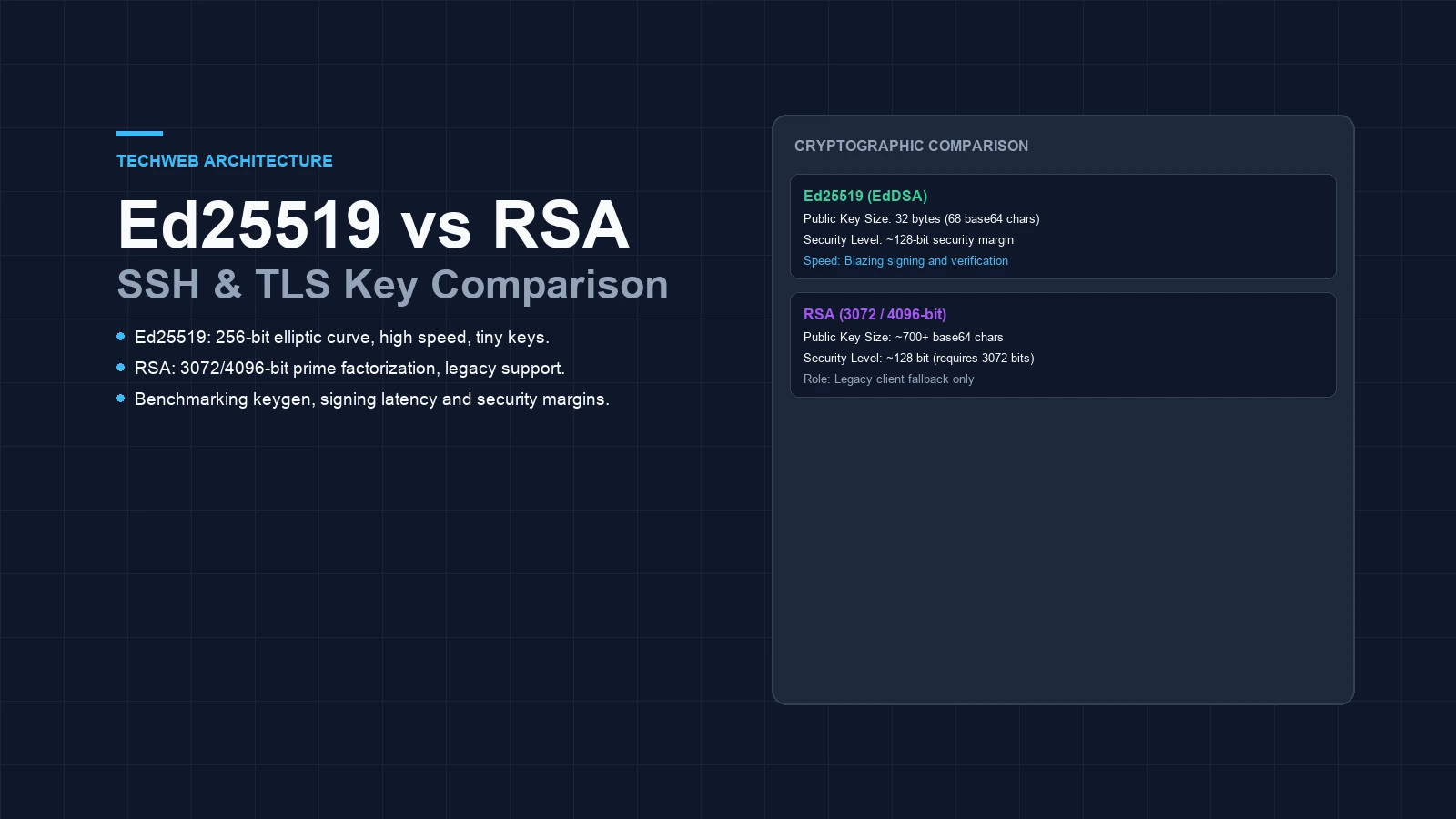
- Ed25519 offers faster signing, constant-time execution, and compact 32-byte public keys.
- RSA requires a minimum of 3072 or 4096 bits to provide equivalent modern cryptographic safety.
- Use Ed25519 as your fleet default and keep RSA strictly for legacy clients lacking elliptic curve support.
Ed25519 vs RSA: core differences
Ed25519 vs RSA: which public key algorithm should you choose? Pick Ed25519 for modern servers. Ed25519 is an elliptic curve signature system based on Curve25519. It gives you strong security, fast signing, and tiny public keys.
RSA is an older algorithm built on prime number math. While RSA stays secure at large key sizes, its heavy keys and slower math make it a legacy fallback today.
Choosing public keys requires looking at real server needs. Key size affects network data. Math speed affects server login rates and Git signing steps. Most of all, algorithm design affects safety against timing leaks. This technical guide compares Ed25519 vs RSA across speed, key size, and OpenSSH settings.
Mathematical foundation: curves versus prime factors
How does the underlying math differ between Ed25519 and RSA? The core difference is simple math structure. RSA relies on the difficulty of factoring the product of two huge prime numbers.
To stay safe against factoring advances, RSA key lengths must grow over time. In contrast, Ed25519 uses twisted Edwards curves over a prime field. This elliptic curve math gives equal safety with much smaller keys.
Key length matters in daily server work. Shorter keys save space. An Ed25519 public key is just thirty-two bytes long. When base64 encoded into an authorized keys file, it takes just sixty-eight characters.
Keys remain clean. It fits on a single terminal line without line wraps. A secure 4096-bit RSA key takes hundreds of bytes and spans over seven hundred characters.
Ed25519 vs RSA practical comparison
Different key types serve distinct functional needs. The table below compares the two algorithms across core performance and security metrics.
| Metric | Ed25519 (EdDSA) | RSA (3072-bit) | RSA (4096-bit) |
|---|---|---|---|
| Key Type | Twisted Edwards Curve (Curve25519) | Integer Factorization | Integer Factorization |
| Public Key Size | 32 bytes (68 characters) | 384 bytes (~540 characters) | 512 bytes (~730 characters) |
| Security Margin | ~128 bits of security | ~128 bits of security | ~140 bits of security |
| Key Generation | Instantaneous (<1 ms) | Moderate (50–150 ms) | Heavy (200–500 ms) |
| Signing Latency | Sub-millisecond | Slower | Substantially slower |
| Side-Channel Immunity | Constant-time by design | Requires blinding code | Requires blinding code |
| Default Recommendation | Modern Standard | Legacy Fallback | Legacy High-Security |
Security margins and constant-time execution
Security margins and side-channel safety set modern algorithms apart. Security margins matter. NIST guidelines rate Ed25519 at about one hundred twenty-eight bits of security. To match that security level, an RSA key must be at least 3072 bits long. An older 2048-bit RSA key only gives roughly one hundred twelve bits of security margin, which modern standards now phase out for sensitive data.
Ed25519 runs in constant time. Every math step takes the exact same number of CPU cycles. This steady timing stops side-channel leaks. Older RSA setups can leak secret key bits through tiny timing variations unless developers apply complex mathematical blinding code.
Performance and system throughput benchmarks
Speed tests show clear operational gains for Ed25519. Making a new Ed25519 key takes a fraction of a millisecond. Building a 4096-bit RSA key forces the system to search for large primes, eating several hundred milliseconds of CPU time. On small cloud servers or IoT boards, that delay is easy to notice.
Signing and checking speeds also favor curve math. Ed25519 signs data much faster than 4096-bit RSA. For busy jobs like code signing or continuous delivery checks, these CPU savings cut server load. Checking is equally fast, helping servers handle incoming SSH logins with little delay.
Platform compatibility and enterprise support
Compatibility across modern systems is fully solved. OpenSSH added native Ed25519 support in version 6.5 back in early 2014. Today, every modern Linux distribution, macOS version, and Windows OpenSSH client supports Ed25519 by default. Major Git hosts like GitHub and GitLab support Ed25519 for commit signing and repository access.
When should you still use RSA on production servers? Old gear needs fallbacks. The only real reason to use RSA today is legacy client support. If you manage old network switches, legacy hardware tokens, or old appliances that lack curve libraries, you may need RSA. When old tools force you to use RSA, always require a key length of at least 3072 or 4096 bits.
Generating and managing modern keys
Managing SSH keys across large developer fleets requires good tooling. Load keys into ssh-agent. Using an agent keeps private keys in memory so you enter your passphrase once per session. You can also use hardware security keys with FIDO2 support alongside Ed25519-SK for hardware-backed security.
Generate an Ed25519 key with this standard OpenSSH command:
ssh-keygen -t ed25519 -a 100 -C "user-workstation-2026"The flag -o saves the private key in the modern bcrypt format rather than legacy PEM headers. Passphrases add protection. The flag -a 100 sets one hundred key derivation rounds, slowing down brute-force passphrase attacks. Always protect private keys with a strong passphrase to guard your credentials against disk theft.
Server configuration and post-quantum readiness
Configuring your OpenSSH server to enforce modern keys protects systems. Keep remote access safe. In your sshd_config file, you can set allowed host key algorithms cleanly. Read our technical guide on testing emergency admin access before altering remote login rules. Also check our rules for key rotation lifecycles to maintain audit readiness.
Planning for future post-quantum security shifts requires clear key tracking. Track all active keys. Neither Ed25519 nor RSA is quantum-resistant against future Shor's algorithm attacks. Check our architectural guide on creating a cryptographic inventory for post-quantum planning to catalog keys across your fleet. Tracking keys today ensures a smooth move to hybrid quantum-safe algorithms when standards land.
Frequently asked questions
Is Ed25519 safer than 4096-bit RSA?
Yes, in daily practice. While 4096-bit RSA gives strong mathematical safety, its bulky keys are slower and more prone to implementation bugs. Ed25519 gives constant-time execution and a high safety margin with far smaller keys.
Why are Ed25519 keys so much shorter than RSA keys?
Elliptic curve math solves discrete logarithms with fewer bits than prime factoring. A 256-bit elliptic curve key matches the security strength of a 3072-bit RSA key.
Can you choose custom key lengths for Ed25519?
No, lengths are fixed. Ed25519 uses a fixed key length of 256 bits (32 bytes). Unlike RSA, where engineers must pick 2048, 3072, or 4096 bits, Ed25519 stops user setup errors by fixing the curve parameters.
Does Git support Ed25519 keys for SSH and commit signing?
Yes, Git supports Ed25519. Modern Git versions support Ed25519 for remote repository access and cryptographic commit signing using SSH signatures.
Sources and documentation
- IETF RFC 8709: Ed25519 and Ed448 Public Key Algorithms for SSH
- OpenSSH 6.5 Release Notes: Native Ed25519 Support
- NIST SP 800-57 Part 1: Recommendation for Key Management