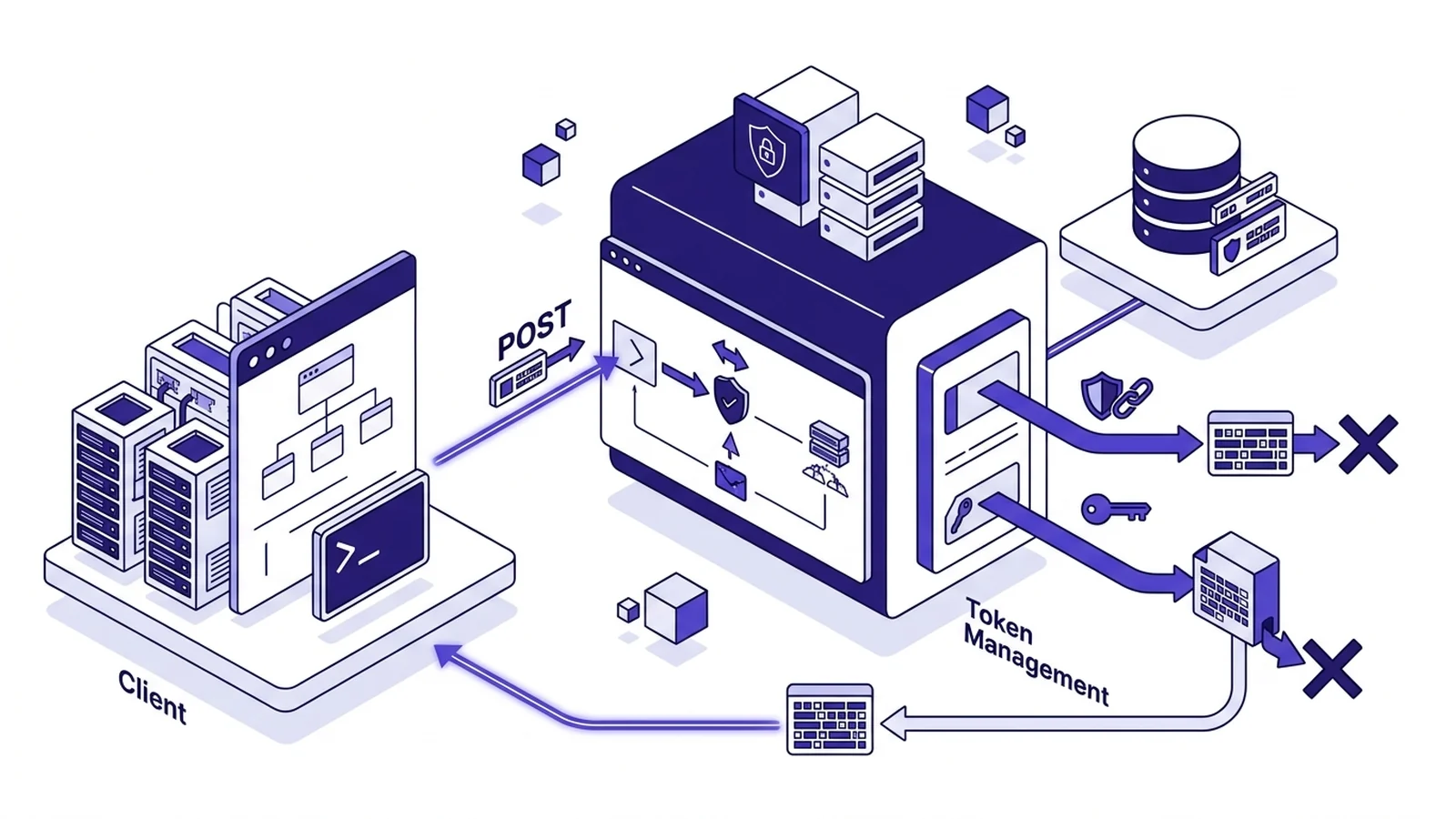
- RFC 7009 defines a clean route to drop active credentials on demand.
- Servers return 200 for missing records.
- Revoking a refresh key drops all child tokens across backend API services.
Understanding the OAuth2 token revocation endpoint
An oauth2 token revocation endpoint lets client apps drop active keys on demand. Under RFC 7009 rules, clients notify the auth host when a user logs out. The host drops tokens instantly. This dedicated route protects backend APIs by closing exposed credential windows before natural expiration timestamps pass.
RFC 7009 sets the formal rule for this flow. It gives software teams a clean guide for user sign out. Following this standard avoids fragile custom tricks.
RFC 7009 protocol mechanics and request format
Clients send drop requests with an HTTP POST call. The payload travels as form data sent to the auth host. Each client signs in with its key. Public apps send an ID string instead.
The body holds two main form fields. The required parameter carries the key string. The optional hint parameter tells the host if the key is an access key or a refresh key.
POST /oauth2/revoke HTTP/1.1
Host: auth.example.com
Content-Type: application/x-www-form-urlencoded
Authorization: Basic czZCaGRSa3F0MzpnWDFmQmF0M2JW

token=rK8j2xL9pQ1zW4vN7mC3&token_type_hint=refresh_token
When the auth host receives this inbound call, it immediately verifies the sender identity. Valid calls pass. If authentication succeeds, the server marks the key record as revoked. If the key is gone, the server returns 200 OK. Attackers cannot guess active keys.
Revocation behavior across token architectures
Token designs shape how fast drops work across web tools. Centralized reference strings drop right away in primary storage. Self-contained signatures act in a different way. Downstream services read them offline. The comparison table below outlines operational trade-offs for each model.
| Storage architecture | Revocation speed | Database overhead | Gateway enforcement method |
|---|---|---|---|
| Opaque reference strings | Immediate (sub-millisecond) | High lookup volume per call | Direct database query or Redis cache check |
| Stateless JWT credentials | Delayed until expiry | Zero central lookup cost | Short TTL windows paired with edge blocklists |
| Phantom tokens (Gateway) | Immediate at edge proxy | Moderate state at edge | Gateway converts opaque token to internal signed JWT |
| Distributed refresh grants | Immediate for future calls | Low write-only storage | Rejection during subsequent refresh exchange flows |
Implementing revocation handling in application code
Writing a reliable handler takes structured validation steps. The server checks headers and confirms client ownership. Then it updates persistent storage and clears edge caches. The Python snippet below shows this operational sequence.
def handle_revocation_request(request, db_session, cache_client):
    client_id, client_secret = extract_basic_auth(request)
    if not authenticate_client(client_id, client_secret, db_session):
        return {"error": "unauthorized_client"}, 401

    credential_str = request.form.get("token")
    if not credential_str:
        return {"error": "invalid_request"}, 400

    type_hint = request.form.get("token_type_hint", "refresh_token")
    record = db_session.find_credential(credential_str, hint=type_hint)

    if record and record.client_id == client_id:
        db_session.mark_inactive(record.id)
        cache_client.set(f"revoked:{credential_str}", "1", ex=record.remaining_seconds)
        if record.is_refresh_grant:
            db_session.revoke_child_access_keys(record.id)

    # RFC 7009 requires 200 OK even if token does not exist
    return "", 200
Notice the cascading cancellation logic inside the database update. Inspect it carefully. When an administrator revokes a parent refresh grant, the server cancels each related child access key. Leaving child keys active after parent termination creates a serious security gap.
Cascading revocation and edge gateway synchronization
Cloud environments route traffic through reverse proxies and edge gates. When a client drops keys, backend services must learn about dead keys fast. Short expiration windows reduce risk. Still, they leave a window of exposure.
To keep services in sync, auth servers share drop notices with fast memory caches. The sequence table below details the stages of a standard logout operation.
| Execution order | Source component | Destination service | Operational task |
|---|---|---|---|
| 1. Client logout request | Web or mobile client | OAuth2 Revocation Endpoint | Sends POST /oauth2/revoke with refresh credential |
| 2. Identity verification | Authorization server | Client registry database | Validates client credentials and grant ownership |
| 3. Grant termination | Authorization server | Persistent session store | Marks grant and child records as revoked |
| 4. Edge cache broadcast | Authorization server | Redis cluster or Pub/Sub | Publishes revoked identifier with expiry TTL |
| 5. Inbound API block | API Edge Gateway | Resource services | Rejects incoming calls with HTTP 401 Unauthorized |
Security best practices and operational considerations
Securing the revocation path requires attention to transport layers. Endpoints face floods. Adding rate limits on the revocation route prevents denial-of-service disruptions against authorization databases.
Make sure that all drop calls travel over encrypted TLS links. Never accept key parameters in HTTP GET queries. Query strings leave permanent trails inside server access logs and browser histories.
To explore related access setups, read our guide on basic auth vs bearer tokens in modern APIs. If your team manages shared logins across enterprise web portals, examine our comprehensive technical guide on OAuth2 vs SAML authentication differences. See Caddy reverse proxy subpath. You can also inspect our guide on RS256 vs PS256 signature algorithms. Review our notes on TLS 1.3 vs TLS 1.2 handshake speed across web servers.
Frequently Asked Questions
Why does an RFC 7009 revocation endpoint return HTTP 200 for invalid tokens?
RFC 7009 specifies an HTTP 200 response for invalid keys to stop fishing attacks. This ensures outsiders cannot probe which keys remain active.
Does revoking a refresh token also invalidate existing access tokens?
Yes. Standard OAuth2 setups cancel the refresh key. They revoke all active child access keys issued under that authorization grant.
How do resource servers know a stateless JWT access token has been revoked?
Stateless JWT keys need an API gateway cache check. They can also use an edge blocklist to confirm immediate cancellation before their natural expiry.