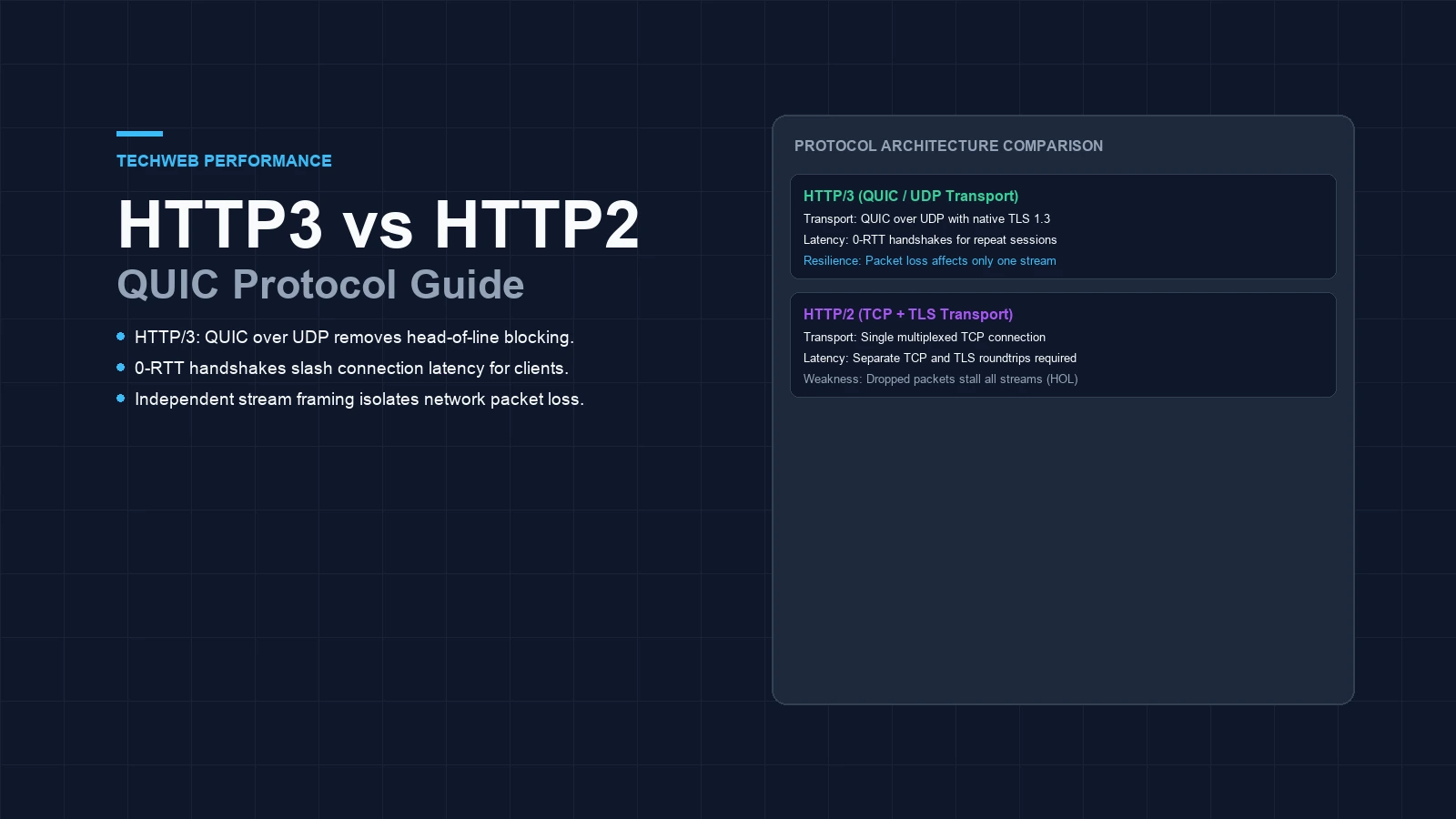
- HTTP/3 replaces TCP with QUIC over UDP to eliminate head-of-line blocking across data streams.
- Integrated TLS 1.3 encryption enables 0-RTT handshakes. This cuts mobile network latency.
- Production deployments use Alt-Svc headers to offer HTTP/3 while preserving HTTP/2 fallbacks.
HTTP3 vs HTTP2: core architectural differences
HTTP/3 replaces HTTP/2 by swapping TCP for the QUIC protocol over UDP. This architectural shift eliminates head-of-line blocking across independent streams and enables 0-RTT handshakes for repeat connections. When comparing http3 vs http2 for fast sites, transport design is the deciding factor. HTTP/2 runs many requests over one TCP stream. In contrast, HTTP/3 drops TCP and sends data over QUIC.
Both protocols use binary framing and compress headers, yet their underlying transport layers behave completely differently. HTTP/2 stalls when network packets drop, whereas HTTP/3 isolates packet drops to keep data moving forward.
The head-of-line blocking problem in TCP
Why did engineers replace TCP? TCP requires bytes to arrive in exact order. In version 2, dozens of streams share one TCP pipe. If one packet drops on a mobile link, the whole connection stalls. The kernel holds all data until the lost packet arrives.
This delay is called head-of-line blocking. Stream sharing helped cut connection limits. Even so, TCP packet drops bring back old delays.
QUIC resolves this architectural flaw by isolating independent data streams within individual UDP packets. Each QUIC stream runs on its own. When a UDP packet drops, only that single stream waits. All other active assets keep loading without pause.
HTTP3 vs HTTP2 protocol comparison matrix
| Protocol metric | HTTP/2 (RFC 7540) | HTTP/3 (RFC 9114) |
|---|---|---|
| Transport protocol | TCP (Transmission Control Protocol) | QUIC over UDP |
| Encryption integration | TLS 1.2 or TLS 1.3 (decoupled layer) | TLS 1.3 (natively embedded in QUIC) |
| Initial handshake cost | 2 to 3 network roundtrips (TCP + TLS) | 1 RTT initial, 0-RTT for repeat connections |
| Head-of-line blocking | Present at the TCP transport layer | Eliminated across independent streams |
| Header compression | HPACK (static and dynamic tables) | QPACK (out-of-order stream compression) |
| Connection migration | Breaks on client IP or network change | Supported natively via QUIC Connection IDs |
| Firewall traversal | Standard TCP port 443 (universal) | UDP port 443 (may be blocked by strict firewalls) |
Faster connection handshakes with 0-RTT
High latency slows down mobile users. Setting up a secure version 2 session takes several trips. The client runs a TCP handshake. Then it negotiates TLS keys. This exchange adds round trips before data can move.
Version 3 combines transport and encryption into one step. The protocol embeds TLS 1.3 parameters in its first packet. New connections set up in a single round trip.
Returning users get zero round trip restarts. Clients send data immediately. Just like using modern Ed25519 keys for quick setup, shorter handshakes help pages load fast.
Connection migration across mobile networks
Mobile devices shift between network interfaces frequently throughout normal daily usage. A device may drop Wi-Fi and switch to cell data mid-stream. Under legacy version 2, TCP binds tightly to an IP address. When your IP changes, the TCP socket breaks. Active downloads fail and must start over.
The protocol identifies connections with a Connection ID. The IP address can change freely. The client simply sends UDP packets from the new IP using that same ID.
The server accepts the token and keeps sending data. This flexibility keeps mobile apps smooth. Paired with lean assets like modern WOFF2 fonts, network migration stops mobile stalls.
Configuring HTTP/3 and Alt-Svc headers in production
Browsers cannot assume a host runs HTTP/3. Corporate firewalls often block UDP traffic on port 443. To stay safe, browsers connect over HTTP/2 first. The origin server advertises version 3 support using an Alt-Svc header.
Here is a sample Nginx block advertising QUIC support on UDP port 443:
server {
    listen 443 ssl;
    listen 443 quic reuseport;
    ssl_protocols TLSv1.3;

    # Advertise HTTP/3 availability to supporting clients
    add_header Alt-Svc 'h3=":443"; ma=86400';
    add_header X-Early-Data $early_data;
}
The Alt-Svc header directs browsers to negotiate version 3 on their next visit. If UDP is blocked, the browser falls back to version 2 without errors. Much like DNS over HTTPS runs beside basic DNS, dual support keeps sites working.
When to deploy HTTP/3 and operational tradeoffs
The new transport protocol is not a universal fix. On fast fiber lines with zero packet loss, version 3 and version 2 deliver matching speeds, meaning the real throughput gains appear almost entirely on lossy mobile links.
Running UDP also takes more server CPU than TCP. Handling UDP packets in user space creates overhead. Plan server capacity carefully. High-traffic hosts need careful kernel tuning to match TCP volume.
Most teams terminate the protocol at a CDN edge or reverse proxy. Proxies handle this well. Edge nodes absorb UDP work while maintaining stable version 2 connections to origins, giving mobile users lower latency without overloading origin servers.
Testing and rollout best practices
Before rolling out version 3 across production, teams should test UDP routing thoroughly across representative networks. Verify network paths first. Some hosting environments restrict UDP packet sizes or rate-limit unestablished UDP flows. Test your traffic early. Monitoring error logs during initial rollout prevents unexpected client disconnects.
In summary, Version 3 represents a major milestone in web networking. Network resilience wins. By decoupling streams from rigid TCP constraints, it delivers resilient performance where modern users need it most: on unpredictable mobile connections.
Sources and standards
- IETF RFC 9114: HTTP/3 Specification
- IETF RFC 9000: QUIC: A UDP-Based Multiplexed and Secure Transport
- IETF RFC 7540: Hypertext Transfer Protocol Version 2 (HTTP/2)
Frequently asked questions (FAQ)
What is the primary architectural difference between HTTP/2 and HTTP/3?
Version 2 runs over TCP with TLS encryption, while version 3 runs over QUIC on top of UDP to remove head-of-line blocking and speed up handshakes.
Does version 3 replace TCP with UDP entirely?
Yes. Version 3 relies on UDP at the transport layer, relying on QUIC to handle congestion control, packet ordering, and cryptographic verification natively.
How does QUIC resolve head-of-line blocking?
QUIC isolates individual streams within UDP packets. A lost packet only delays the single stream it belongs to, leaving all other active streams unaffected.
How do web servers advertise version 3 support to browsers?
Servers send a standardized Alt-Svc header directing client browsers toward HTTP/3 on UDP port 443 on future requests.
More in this sectionTechnology →